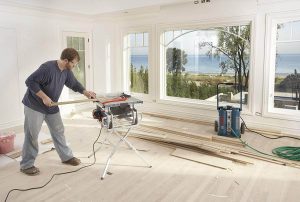
 Table saws are pretty much a requirement for those who are woodworking but some of them aren’t quite as portable as we’d like. There’s simply no way to cart some of them around, which can make them a pain on site. If you’ve been looking for the best portable table saw then you’re in the right place, we tested twelve different portable table saws and decided to bring you six of them.
So, let’s jump right in with our favorite and then we’ll discuss the ins and outs of making sure you have the right saw to cart around.
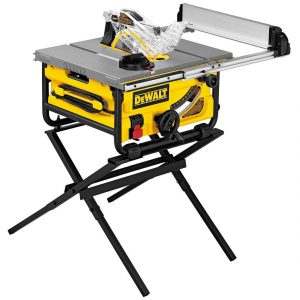 Of all the saws we tested, this portable and powerful saw took the cake. It’s an excellent addition to your tools and you’ll find that it’s much more powerful than you thought possible while being easy to move around wherever you’re working. The included stand is just icing on the awesome cake that is the DeWalt DW745S.
Table saws often spend the bulk of their time on a bench in a workshop. When that’s the case you’ll often find that the weight and bulk of the machine aren’t a serious problem.
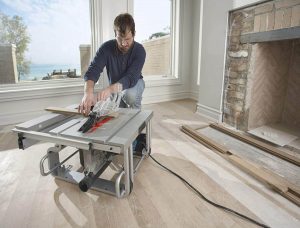 However, for those who are working on job sites or attempting to do a large home improvement project, it can be downright painful to have to return to the bench every time you need to make a cut. Especially if you find yourself making fine adjustments on a regular basis.
That’s where job site saws come in: they’re made to be lightweight and portable without sacrificing the quality you’d normally associate with a given brand. They deliver too, provided that you’re willing to spend a little bit more money to pay for the superior engineering.
Basically, if you need to move your saw frequently for a given application then you’ll be in good hands with a portable table saw.
The majority of table saws these days are job-site saws, which are meant to be moved and we’d already done testing on a variety of standard table saws so we focused on models specifically designed to be moved frequently.
We were fortunate enough to have several framers who’ve helped us with our testing before and they were the first people we went to when trying to decide which saws to test. After getting models and brands written down we checked the general online consensus about each saw before bringing them in for testing.
We also took into account the following when making our final decisions.
We harp on build quality a lot here, but the truth is that it’s the deciding factor for us with most tools. Without solid quality of construction, there’s simply no point in having the tool, especially with a workhorse like a table saw.
All of the options we picked were solid, with no wobbles or other issues that can occur when a table saw isn’t well put together. We went with superior construction even if it meant a little bit more weight, ensuring that we were only recommending good tools.
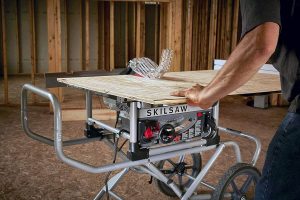 As a workhorse saw, table saws need power. While many of the portable models have slightly lower power levels than their heavier competitors we still found it to be extremely important.
For dedicated ripping of larger wood, you may need to go with something which is a little bit heavier but for the most part, we found that tearing apart construction timber was easily accomplished with all of the saws that we tested although we noted which ones made it easier.
As with any table saw, these essentials were tested to allow us to make sure that everything worked smooth and safely. Riving knives are essential for long rips, keeping the piece from splitting or causing dangerous kickback while fencing is required for exacting, precise cuts.
In any case, we fully tested these while we were working with the saws to ensure that they were up to our standards.
The entire point of a portable table saw is to be… well, portable. Some were heavier than others by a large margin but these often came with a mostly integrated hand truck and folding frame which we felt warranted their inclusion.
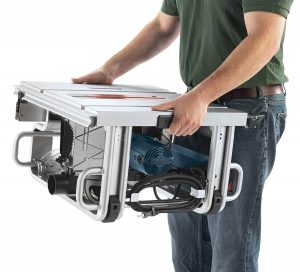 Others were simply lightweight, well-built saws.
You’ll see that during testing this time around it was our main concern. It’s hard to recommend a portable saw which weighs 60lbs and has no wheels to move it around on after all.
One other thing we looked for when checking out these saws was the frames. Some of the higher-end saws come with steel tubing which is arranged in such a way as to absorb the impact of a fall, which we think is much higher when you’re regularly moving a saw around.
You’ll see in the reviews ahead which had them and what we thought of them.
At A Glance:
Undoubtedly the best received of all of the saws we reviewed, this excellent option from DeWalt stood out from the competition with relatively low weight, an excellent folding stand, and enough power to make short work of everything we threw at it.
Don’t be confused by the seemingly low RPMs, the DeWalt DW745S stood up better than any of the others on our list when it came to use and abuse and it’s a fine workhorse saw with a middling price point that makes it accessible even for hobbyists.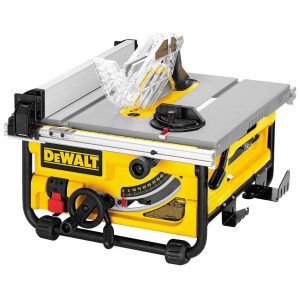
The protective frame is an added bonus and went through our drop test with flying colors. All of this together added up to an excellent portable table saw that we strongly recommend taking a look at, regardless of your intended usage.
It doesn’t accept a dado stack and its surface is a bit limited, but we feel it’s an acceptable trade-off for the power and the lighter weight of the saw as a whole.
 At A Glance:
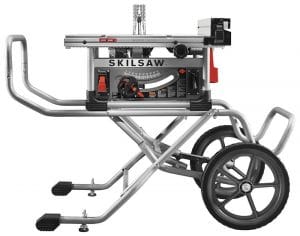
The heaviest of the saws that we used, but also one of the greatest of those that we tested. The weight was mitigated largely by a well-engineered set of wheels and balance point that made it a breeze to take up and down stairs despite the greater weight.
This saw also had a surprising rip capacity, comparable to any standard job site saw and it supports the workpiece well enough that even a single person can use it to its full extent. Because of this, however, it also isn’t the most compact saw, especially once the frame was taken into account.
The fence was surprisingly smooth, which we didn’t expect after working with some of the lower end SKIL table saws in the past. Indeed, it’s best to forget the brand entirely if you’ve had bad experiences in the past. It’s simply a cut above their normal fare.
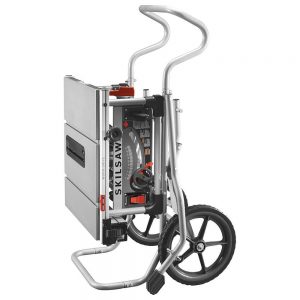 It’s not perfect: some people will have trouble hauling it up stairs and there’s a bit of play in the locking components. Still, it’s a fantastic saw for everyday work use and if you can shell out for it it will make a welcome addition to the workshop for hobbyists.
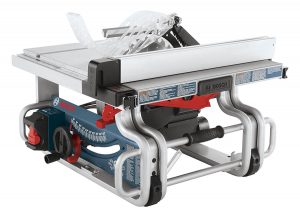 At A Glance:
This was the most compact of the saws we tried except for the budget option. While it seems heavy, the convenient carrying handle actually made it surprisingly easy to move around during testing as well.
The big draw is the high RPM and smaller footprint. While a small footprint isn’t right for every job it certainly makes the saw easier to store and transport while you’re working on a job and the high no-load RPM makes it cut smoothly as long as you don’t bog the saw down during cutting.
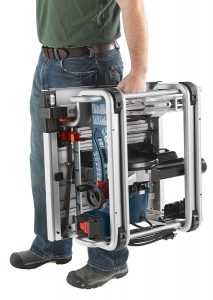 The build quality is absolutely exceptional on this one, and the frame made it through our drop test very well.
It’s a bit expensive and doesn’t come with a stand, although one is available, but as a workhorse saw for those jobs where you’re constantly on the move it really shines. It’s also great for workshops with limited space due to the smaller surface area it takes up.
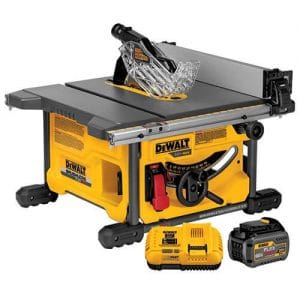 At A Glance:
We tested three different battery-powered saws and two of them were rather unimpressive. This one, however, shone even when compared to a cheap plug-in table saw and the low weight and ability to use 60V DeWalt batteries put it ahead of the competition.
It includes a roll cage as well. The fact that it can cut quickly and easily without being tied to a plug is, of course, the big draw and makes it more portable than the majority of the saws that we tested in sheer utility.
The fence could be a bit smoother and a carrying handle would have been a nice touch but the low weight and ability to cut without being tied… well, that makes it one heck of a portable table saw in the end.
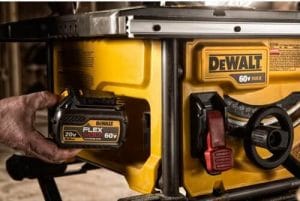 The downsides are those which are common to battery-powered tools. It’s a bit underpowered compared to the others on our list and you’ll need to make sure you have enough batteries to finish the job.
 At A Glance:
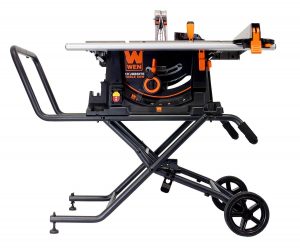
We love WEN for their innovation and in this case, they made an excellent portable saw with a huge rip capacity thanks to the table. It’s powerful enough to make short work of construction timber and relatively light considering it’s attached to a wheeled frame.
The wheeled frame was a big draw. It makes it much easier to go up and downstairs and the wheels are well-made for rough terrain like you’ll find around most job sites. The extendable table is just a bonus on top of everything else.
It even has onboard storage for extra blades and tools. All of this adds up to make it a complete package right out of the gate and it’s an awesome option for the price.
That said, it also suffers from a relatively mediocre build-quality. As a workshop saw it should last a long time, but we can’t say it’s recommended for framers and carpenters who will need to use it extensively every day. You’ll also want to keep an eye on the blade when raising or lowering, it has a tendency to shift about a degree to either side so you’ll need to square it if you’re changing the blade height.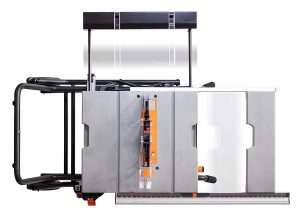
 At A Glance:
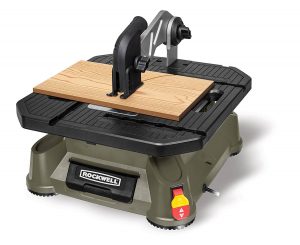
Small, super lightweight, and overall a great portable saw for those without a lot of physical strength, the RockWell BladeRunner X2’s biggest flaw is that it’s underpowered. Of course, at less than half the weight of the nearest one on our list… it’s a trade-off that you may be willing to make.
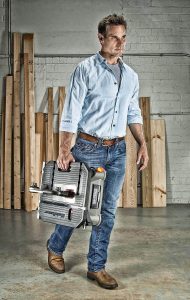 The saw is well put together, especially considering the price. Keep in mind this one is a bit different than most on the market, not using a circular saw blade but instead a set up closer to a jigsaw. It’ll still rip 2x4s, however, and we proved it during our testing.
That said, for serious construction lumber, this one isn’t going to fit the bill. The throat capacity is too limited overall and even a 2×4 was pushing it a bit. It’s a great option for flooring, paneling, and other thin pieces of wood and it’ll add quite a bit of capability to your home shop.
There really isn’t much difference between the usual job site table saw and a portable saw. For the most part, portable saws will have a more rugged frame and the internals tend to be better constructed in case of a drop.
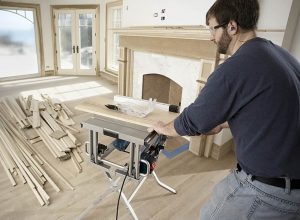 Chances are you’ll want to take advantage of the portability of your saw as much as possible. Most portable saws are around ¾ the weight of a “normal” table saw, with some being even less. Don’t be too turned off by higher weight if there are wheels, however, we found that as long as the tool was well balanced they were even easier to move than lighter saws.
If you’re familiar with a hand truck then you’ll have no problem with a wheeled frame. They’re excellent for stairs and other obstructions and the ones which we selected had robust wheels to handle decently rough terrain although you’re unlikely to want to go mountaineering with one.
Always support a carryable saw with both hands while moving unless it has a carrying handle designed with a single hand in mind.
One key tip? Always keep the guard on while moving the saw, if you remove it then you’ll want to lower the blade all the way to avoid mishaps.
If you opt for the battery-powered option it’s also a good idea to make sure that you remove the battery before you move the saw. They’re relatively safe but you really don’t want the saw to turn on when you’re moving it and trying to catch it during a drop can be disastrous.
 A portable saw without wheels should be within your comfortable carrying capacity. If it’s not, you really aren’t going to be able to take advantage of the ability to move the saw around.
It’s also a good idea to plan out where you’ll plug the saw in as well. If you’re running a long extension cord then you should unplug the saw while moving. This avoids both accidentally powering the saw and catching the cord to cause a fall while you’re on the move.
Making sure that you have an excellent portable table saw is a great idea, and finding the best takes some work. All of the saws we reviewed are perfectly serviceable, but it really depends on what your final intention with the saw is if you’re looking for the best.
Regardless, portable table saws are awesome to have around. Check them out today and keep yourself moving and cutting with the one that best suits your needs.