 After a bit of analysis, we’re here to bring you the best brad nailers around. They’re a great way to lower the amount of work you need to engage in when you’re hanging moulding or other lightweight trim. Of course, finding a reliable and useful one can be a pain, however, so let’s dig into the meat of the matter and we’ll show you exactly how to get the right one for your needs.
 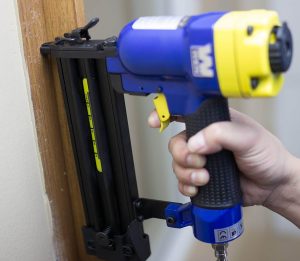 Many people aren’t aware of the difference between brad and finish nailers. As a general rule, brad nailers aren’t suitable for all trim, instead, the thinner gauge nails they use are primarily good for lighter moulding, trim, and other thin pieces.
The big advantage of brad nailers is that you won’t have to use wood putty to cover the holes in most cases since the smaller nails used don’t leave large holes.
 They are a less powerful tool as a whole and the thinner gauge nails used can’t support as much weight, so they’re not suitable for all tasks. They’re still a great thing to have around the home shop, however, and most people will get more use out of them than a finish nailer for home DIY projects.
As a general rule, you’ll find that brad nailers shoot 18 gauge nails while finish nailers will shoot 15 gauge. If you’re restricted to only one then you’ll want to look at the projects you want to get done around the house or shop before picking, but most people will end up picking up both eventually just for the convenience factor.
When we began to select the brad nailers we wanted to review for you we had to make sure they had the following qualities:
 A brad nailer which can’t sink the brad fully in a surface is a real pain. It becomes a glorified setter since you’ll need a punch and a hammer to sink them into the surface. A hammer would be sufficient in many cases, but since they’re often used on cosmetic surfaces you’ll end up damaging the trim or moulding in a cosmetic way.
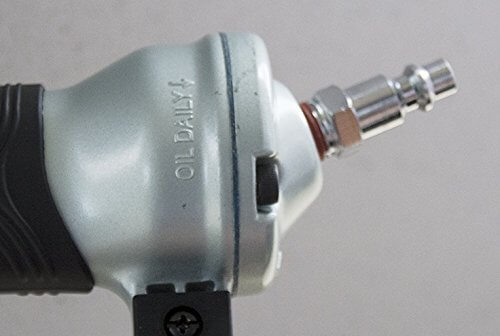
As a general rule, someone who’s serious about setting brads is going to want something pneumatic since they’re the most reliable and powerful of the bunch by a long shot. They also require an air compressor, which isn’t something that everyone has in their garage.
Instead, many home DIYers opt for an electric option. If you’re careful about selection then you’ll be able to find something which will set brads all the way down but there are certainly a large number of subpar options out there.
However, being burdened by a cord can make some jobs hard, so some people opt for a battery powered option. The best of these will still set in wood, mediocre ones will set well in plastic, and a bad one probably won’t even do any damage to your hand. In any case, you’ll only get a limited number of shots per battery charge.
Which you go with will largely depend on your usage, but if you already have an air compressor we strongly recommend a pneumatic option.
Hanging trim and the like can be pretty time-consuming. That means you’re going to have that brad nailer in your hand the whole time you’re working.
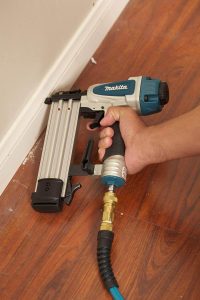 Most of us require a bit of an ergonomic grip in order to use the nailer for an extended period of time. For professionals, this becomes even more important, since you’re likely to be using one all day and taking time off to rest your wrists really isn’t an option.
Included in this is the weight of the nailer, especially for trim since you’ll most likely be holding it over your head while working with it.
Different nailers can fire different lengths of brads. A wider range will make it useful in more varied situations than you’d be able to get with a tighter range.
If you are restricted, you’ll find that 1 ½ brads are about the average you’ll need for baseboards and trim.
 There are a few other things to keep a lookout for, depending on what exactly you need.
The big one is being able to dial the depth adjustment to where you need it. The rest are pretty niche, but many people find them to come in handy:
The list could go on and on but instead, we’ll just indicate what each of the models we selected for you has going for it and let you make the decision.
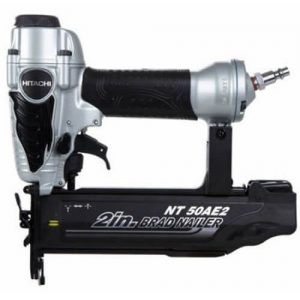 If you’re looking for a pneumatic nailer that can go the distance, then you’ll find yourself well served with this model from Hitachi. It’s a durable piece of work, and it can fire brads from ⅝ to 2”, giving it one of the widest ranges of all of the models we tested out.
It’s easily able to switch between firing modes as well, allowing for bump fire or contact firing modes with the flip of a single switch. Add in the fact that it has a tool-less unjamming method and you’ve got a clear winner when it comes to convenience.
It also has depth adjustment, and it seems to drive the brads true to depth in just about any material that we tested it out on. The magazine is extremely large, and the bottom-feeding mechanism allows you to quickly reload when you’re out.
All of this together adds up to a powerful little nailer with a ton of potential if you’re willing to invest in a compressor as well. It’s still not perfect, of course, it tends to leave oblong holes if not fired at a consistent angle and we found it to be quite hard to shoot at any angle other than dead on.
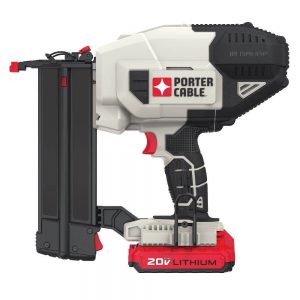 While pneumatics and plug-in models tend to be quite a bit more powerful, there’s something to be said for the ease of use that comes with a battery powered nailer. Porter-Cable’s PCC790LA is undoubtedly the best of the lot.
While it’s not going to compete with our favorite pneumatic model when it comes to sheer power we ran into virtually no issues with it. It’s able to fire around 1,300 brads per fully charged battery and it holds 100 brads per load in the front feeding magazine.
The quality of life features shouldn’t be discounted either. There’s an LED light on the front, it comes with depth adjustment, and it’s extremely light for a battery-powered model, coming in at just under 6 pounds.
There are a couple of issues we noticed. The biggest one is that it will take most people a bit of time to get used to the lag between pulling the trigger and the brad firing. The weight is also a bit high if you’re used to air driven options.
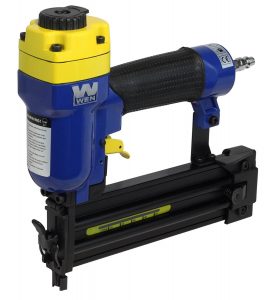 While we really love the Hitachi model we reviewed above, it’s also a little bit on the expensive side. If you’re just doing a small project around the house and don’t quite want to make the investment then WEN’s 61720 might be just what you’ve been looking for.
This model provides quite a bit of power, like most pneumatics, at the expense of some quality of life features that we expect in more expensive models. Like most of WEN’s tools, there are a few basic upgrades which can be implemented, including a 2-in-1 model available for a few dollars more.
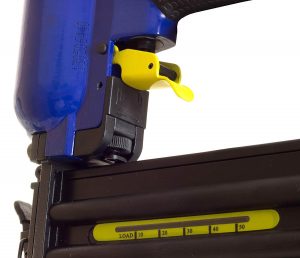 It holds 100 brads at a time and has a quick release lever to allow you to clear jams relatively easily. It also has an adjustable exhaust port so you’re not constantly getting the wind blown into your face while you’re using it.
On the other hand, it’s not quite as durable as the bigger names in the industry and it has a tendency to not feed as well as we’d like. Still, for the hobbyist, the price point makes it an attractive purchase.
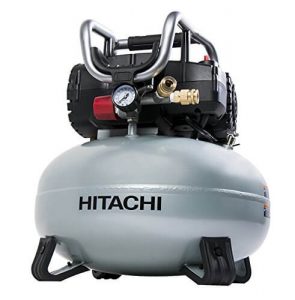
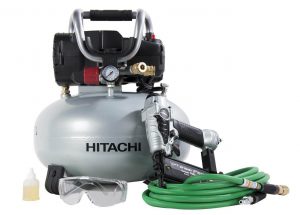 If you don’t have an air compressor, it can often be a daunting choice to find the right one to go with your brad nailer. Thankfully, Hitachi produces this excellent combination kit which will allow you to get both in the same place with a big brand behind them.
This kit includes our favorite of the pneumatic brad nailers which we fired, as well as an excellent 6-gallon pancake compressor. The compressor is the main draw for most of us since it really can be hard to figure out which is the best suited for your home.
The compressor itself is rugged and reliable. Since pneumatic nailers use very little air per release the capacity is just about perfect and it all adds up to a match made in heaven.
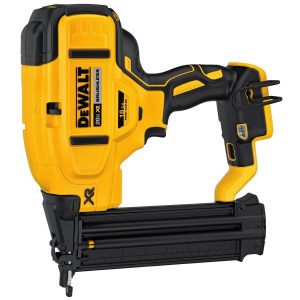 If you don’t think the Porter-Cable model that was our favorite is going to cut it, but you’re not ready to switch things up to a pneumatic just yet then we think you should take a good look at this excellent model from DeWalt.
The biggest problem which most people will have with it is the cost. Other than that you’ll find that it beats out just about every other battery-operated model around when it comes down to it. It’s an excellent way to get ahead, especially for professionals.
The battery is also compatible with DeWalt’s entire impressive line of 20V tools. If you’ve already got any of them around then you can even just go with the bare tool option, which will allow you to save some serious money.
We really couldn’t find any flaws with this one other than the extremely high price in comparison to most of those that we picked for this round-up.
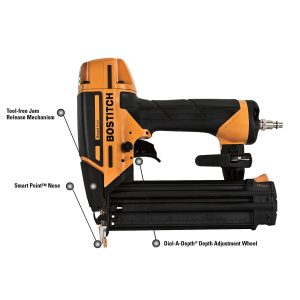 If you’re looking for something to do extreme precision work, such as picture frames, with then you’ll be well served with the Bostitch BTFP12233 nailer. Just keep in mind it’s pneumatic so you’ll also need a compressor in your workshop.
The extra precision here comes from the tip, which is tiny in comparison to most of those on the market and doesn’t require the user to press it down all the way in order for it to be used. It’s a nice touch and with careful hands, most people will find it much more precise than the average brad nailer.
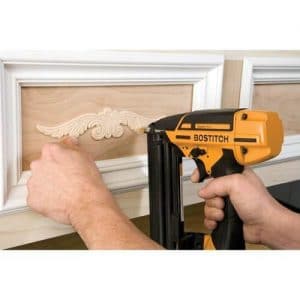 It also has a remarkably accurate depth meter, which allows for the countersinking of the brads at just the right depth in order to ensure a professional finish. The only real quality of life feature it lacks is an LED light, so make sure you have a good worklight when you’re using it and you’ll be fine.
Of course, all of this comes at a fairly high cost and the fact that it doesn’t have any mechanism to keep it from firing once you’ve hit the end of the magazine.
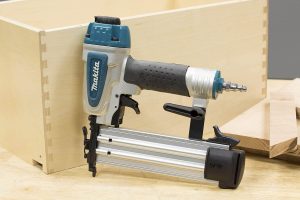
Not everyone has hundreds of dollars to drop on a brad nailer when they first begin in their profession. If you’re in that boat, then you’ll want to take a closer look at the Makita AF505N. It’s a professional quality tool for a remarkably low price.
It has most quality of life features we’ve come to expect, although it still lacks the LED light which only seems to be found in high-end battery-powered models. This includes being able to move the exhaust in whichever direction you want a tool-less jam clearing mechanism.
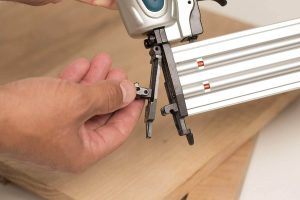 On top of that, it’s quite robust although it does lack a little bit in the ergonomics department. It even comes with a belt hook that can be rotated to allow you to find a way to place the tool where it’s out of the way while you’re climbing ladders or doing whatever else needs to be done on the job site.
It does lack a dry-fire lockout, but there’s a red indicator light which will turn on when you’re low on brads. That said, it’s a remarkably robust and consistent little nailer and most people will be glad that they picked it up.
If you’re looking for a high-end dual-purpose nailer then we strongly recommend going with the upgrade of the WEN above. On the other hand, for a cheap little nailer that’ll get the job done, the Stanley TRE550Z is a great tool.
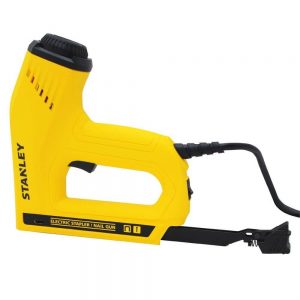
This is a rugged little plug-in device. It comes with the ability to handle both brads and staples, just keep in mind that you’ll probably need an extension cord to get any work around the house done since the cord is relatively short.
The whole thing is in a remarkably unergonomic stapler-style configuration as well. We’d recommend looking elsewhere if you’re planning on doing extensive work around the house. For those smaller projects, it’ll be quite a boon, however.
It lacks basically all of the quality-of-life features that come with our other favorites, but if you’re able to look past that relatively minor flaw and get an extension cord it’s a solid option.
This largely depends on what you’re doing in the first place. For trim and moulding a brad nailer is ideal, and they work quite well for smaller projects. Framing nailers are better for things like fencing or where you might need to be able to hold something with significant weight.
 For a professional, they’re usually the way to go. There are situations where a battery powered nailer absolutely shines, however, including in areas where sound is restricted. A high-quality battery powered option will keep you going for long enough to complete most tasks around the home, however.
As a general rule, you’ll find that brads are 18 gauge nails. This makes them quite small in comparison to what most people think of as a nail, even a framing nail. For comparison “framing” nails are generally 15 gauge, which is quite a bit bigger.
First you’ll need to determine the depth of the molding or trim you’re working with. As a general rule, you’ll want your brads to be three times that depth, so for a ½” trim piece you’ll want a 1 ½” brad.
As with anything made of metal, sometimes you’ll run into faulty brads. For work where the weight is a big concern, stick with brand name brads instead of generics. For things like floorboards or paneling, you’ll generally be fine with generics, however.
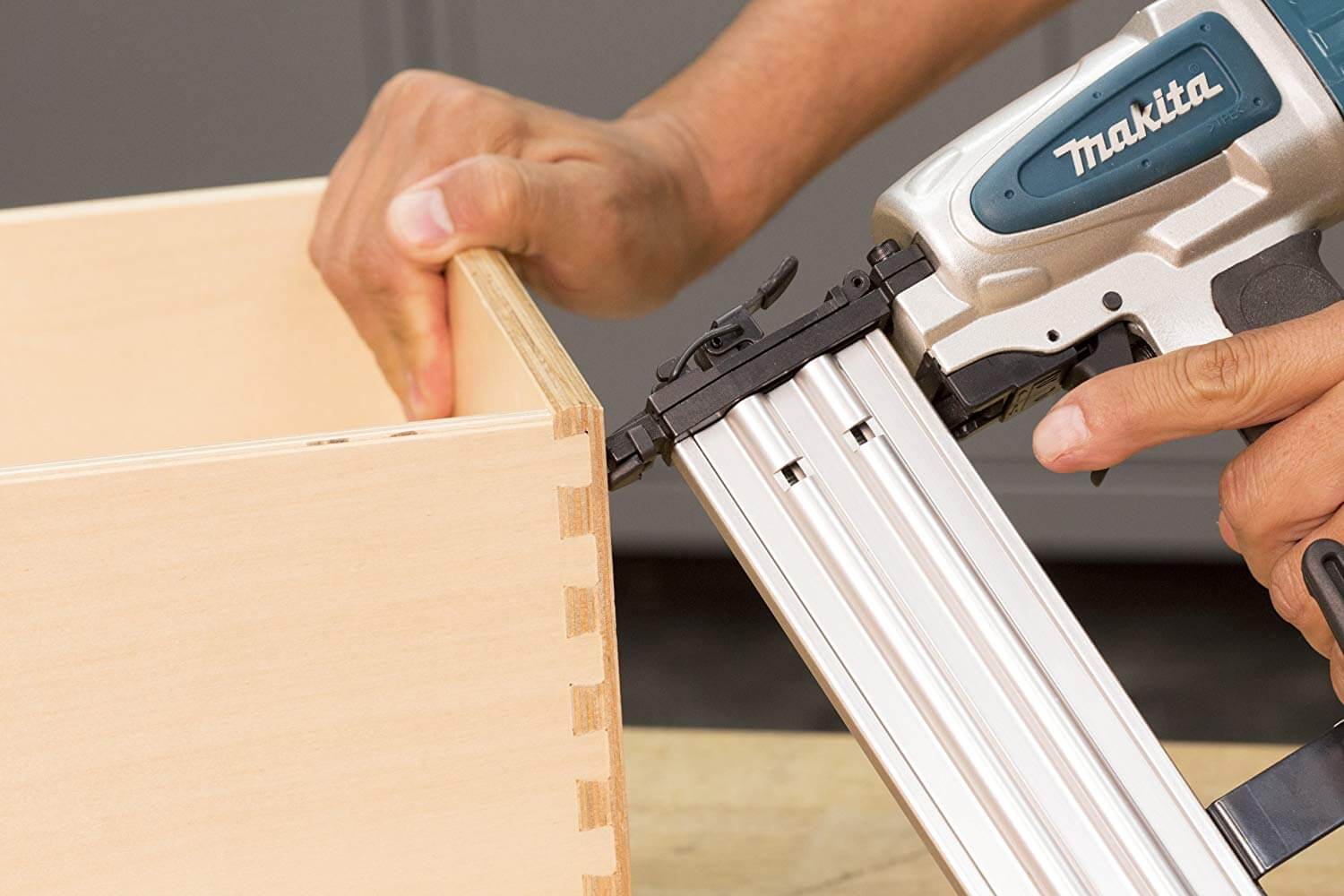 For baseboards, it’s usually best to place one in each end of the board then place your brads every 16-24 inches along the board. For anything which will actually be hanging placing a brad every 6-12 inches depending on the weight of the piece in question is ideal. Always make sure to tack the ends. It’s also important to find the studs for things like crown moulding, as just driving into the wall may not be sufficient.
You shouldn’t use them for anything structural or outdoors as the brads are likely to weather pretty quickly. Brad nailers also generally have straight magazines, which means only very high-quality ones will be able to drive at a decent angle.
Ideally the head should be barely countersunk. This is the big advantage of brads over finishing nails, which usually need to be driven completely in and require more work for a professional finish.
For some people. Staples are great for fastening thin paneling and are often quite useful for crafts. The problem is that most of the dual-function brad nailer/staplers we tested out were on the cheaper side of things.
 Having a brad nailer is essential for anyone who’s serious about home renovation, and those who are into crafts will also find a use. The real problem for most people is going to be finding the best brad nailer for their purposes.
Any of the ones we tested are well suited for the task, so why not pick one up and get your next project started out right?